

Financial markets appeared largely unfazed by the dramatic U.S. seizure of Venezuelan President Nicolás Maduro, but some investors caution that geopolitical risks may be underestimated as President Donald Trump signals a more aggressive stance across the Americas.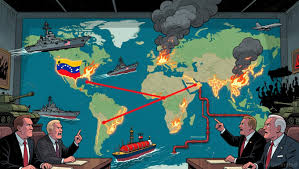
On Monday, investors largely stayed calm. Asian stock markets rallied, oil prices slipped slightly, and gold edged higher as safe-haven demand picked up, after Trump said the United States would assume control of the oil-rich South American nation.
Although the U.S. has not undertaken such a direct intervention in Latin America since its 1989 invasion of Panama, Trump’s warnings directed at countries such as Colombia and Mexico underscored a sharp shift in U.S. foreign policy. The move has brought geopolitical uncertainty back into focus for global markets early in the year.
“This is a reminder that geopolitical risks go far beyond tariffs or trade numbers,” said Vishnu Varathan, head of macro research for Asia ex-Japan at Mizuho Securities in Singapore.
“The key question is whether broader stability in Latin America is now at risk. If so, the spillover effects could be far more significant,” he added.
Markets Stay Calm—for Now
Analysts and investors said the muted reaction to Maduro’s capture reflects Venezuela’s relatively small contribution to global oil supply and the reality that it would take years of investment for production to meaningfully increase.
Still, they warned that the broader consequences of U.S. military action could weigh on investor sentiment, even if the move eventually opens the door to unlocking Venezuela’s vast oil reserves and supporting risk assets over the longer term.
Trump said U.S. oil companies are prepared to take on the challenge of entering Venezuela and investing in efforts to revive production.
“There should be wide-ranging geopolitical implications from this event,” said Tai Hui, chief market strategist for Asia-Pacific at J.P. Morgan Asset Management. “But financial markets are often not very effective at accurately pricing these kinds of risks.”
First Major Market Test of 2026
Global and U.S. equity markets began the new year strongly after closing 2025 near record levels. The prior year delivered double-digit gains despite volatility driven by tariff disputes, central bank decisions, and ongoing geopolitical tensions.
In the near term, analysts expect the most immediate impact to be felt in defense stocks, as countries are likely to continue boosting military spending following Trump’s demonstrated willingness to deploy U.S. force as part of his broader policy agenda.
At the same time, uncertainty surrounding U.S. policy direction could continue to pressure the dollar and weaken its traditional safe-haven appeal, strategists say. While the dollar strengthened slightly on Monday, it is coming off its worst annual performance since 2017, having fallen more than 9% against major currencies in 2025.
Broader Strategic Concerns
For investors, Trump’s actions in Venezuela have also sparked concern about broader global implications, including how China might view U.S. behavior in relation to Taiwan, and whether Washington could pursue a more aggressive approach toward Iran.
However, Li Fang-kuo, chairman of the investment advisory arm of Taiwan-based food conglomerate Uni-President, said markets are not currently worried about an imminent Chinese attack on Taiwan.
“China has conducted military drills around Taiwan, but we haven’t seen anything resembling the prolonged escalation the U.S. showed toward Venezuela,” he said.
Some analysts argue that investors have grown accustomed to Trump’s bold foreign policy maneuvers and are less inclined to react sharply.
Charu Chanana, chief investment strategist at Saxo, said the U.S. move in Venezuela represents more of a geopolitical shock than an immediate oil-market disruption. Unless global supply chains are threatened, she said, investors tend to refocus on interest rates, corporate earnings, and market positioning.
“We’re operating in an environment where geopolitics is no longer a surprise—it’s a constant,” Chanana said.